

Planning transportation for a group event involves more than arranging vehicles. When guests are travelling from different locations, coordinating pickup points, managing arrival times and selecting suitable vehicles can become challenging.
Whether you are organising a family function, a private celebration, a social gathering or a business event, a clear transportation plan helps guests reach the venue with fewer last-minute complications.
If you are planning an event in Nashik, arranging multiple pickup points for events in Nashik requires proper coordination between guests, drivers, vehicle availability and the event schedule.
This guide explains how to organise multiple guest pickups, prepare a practical travel schedule and manage group transportation more efficiently.
Why Is Transportation Planning Important for Group Events?
Guests attending the same event may come from different neighbourhoods, residential areas, hotels or railway stations.
Without proper planning, organisers may face problems such as:
Guests waiting at incorrect pickup locations.
Vehicles arriving at different times.
Confusion about driver contact details.
Delays caused by poorly planned pickup sequences.
Insufficient seating capacity.
Difficulty coordinating return journeys.
A transportation plan prepared in advance helps organisers communicate clear instructions and reduce unnecessary confusion.
1. How to Plan Multiple Pickup Points for Events in Nashik
The first step is to identify where guests will travel from.
Create a list of all expected pickup locations before arranging vehicles.
For example, an event organiser in Nashik might receive pickup requests from:
College Road
Gangapur Road
Indira Nagar
Panchavati
Nashik Road
Satpur
CIDCO
These are illustrative locations, not a recommended fixed route.
Record the number of guests travelling from each location. This will help you understand how many vehicles may be required and whether nearby guests can share transportation.
Information to collect
For each pickup location, record:
| Details | Information required |
|---|---|
| Pickup location | Exact address or landmark |
| Guest count | Number of passengers |
| Contact person | One responsible guest |
| Pickup time | Preferred reporting time |
| Destination | Event venue |
| Return requirement | Yes or no |
Avoid relying only on general area names. Confirm the exact meeting point with each group.
2. Group Nearby Pickup Locations Together
Once you have collected the addresses, identify locations that are reasonably close to one another.
The purpose is to reduce unnecessary travel between pickup points.
For example, if several guests are travelling from nearby residential areas, they may be able to use one common meeting point.
Consider these factors before combining locations:
Distance between pickup points.
Number of passengers at each location.
Road accessibility.
Expected traffic conditions.
Time available before the event.
Whether guests can comfortably reach a common meeting point.
Do not combine locations simply because they appear close on a map. Actual road access and travel conditions should also be considered.
3. Decide How Many Vehicles Are Required
Vehicle selection should depend on the number of passengers, luggage requirements and the distance between pickup points.
Before confirming transportation, calculate the passenger count for every proposed vehicle.
Consider the following options:
Sedan: Suitable for smaller passenger groups when seating capacity permits.
SUV: Useful when a group needs additional passenger or luggage space.
Larger family vehicle: Consider when more passengers are travelling together.
Always confirm the actual seating capacity and luggage space before booking.
Do not plan a vehicle at its maximum theoretical capacity without considering passenger comfort and luggage.
If the event involves guests travelling from several different areas, using separate vehicles may be more practical than making one vehicle cover every location.
For events requiring different vehicle categories, you can also explore car rental in Nashik and compare suitable options based on your group size.
4. Prepare a Pickup Schedule for Every Vehicle
A clear pickup schedule is one of the most important parts of multiple-location transportation planning.
Instead of giving every guest the same reporting time, prepare a separate schedule for each vehicle.
Your schedule should include:
Vehicle identification.
Driver contact details.
First pickup location.
Additional pickup locations.
Reporting times.
Final destination.
Event arrival deadline.
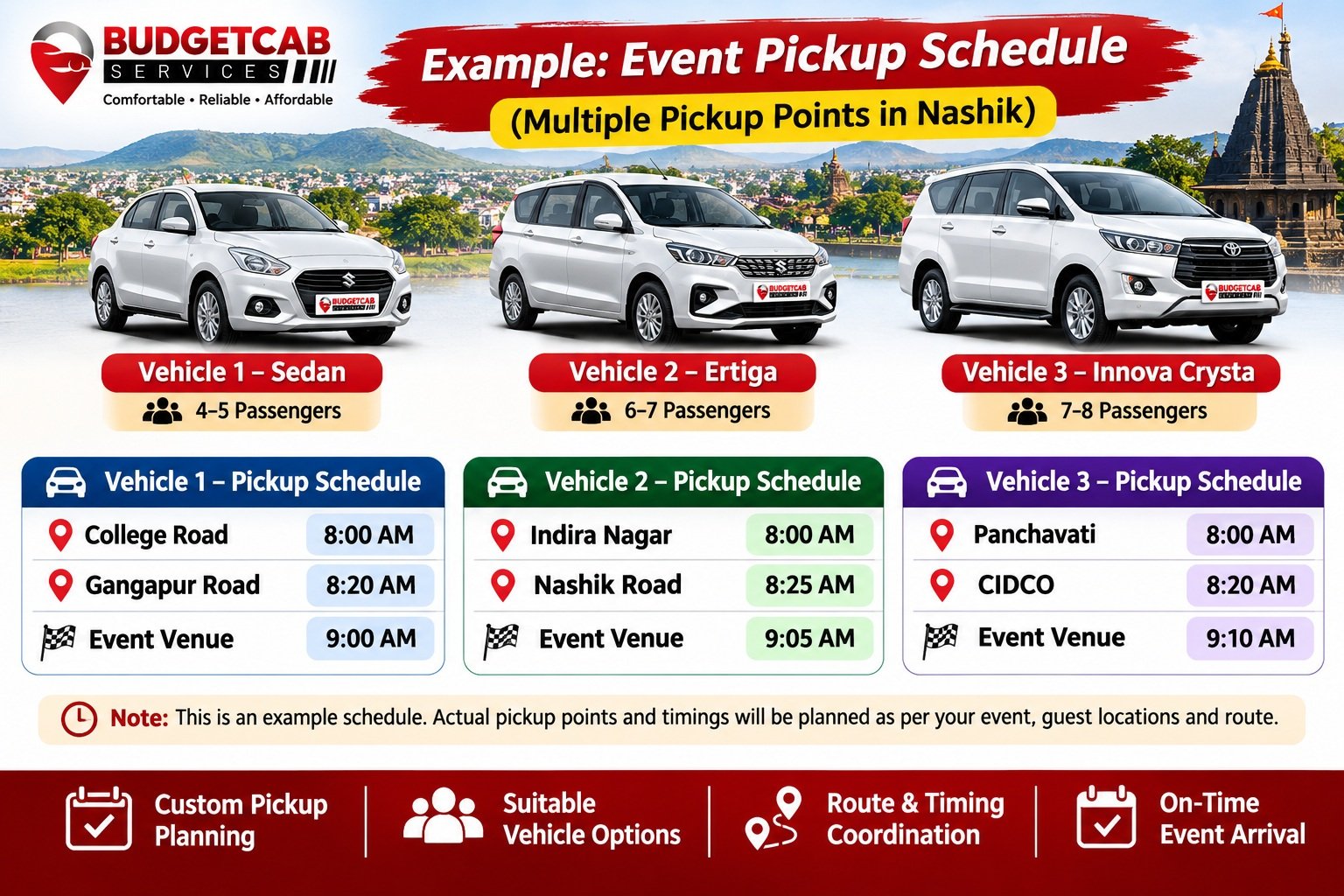
Example of an event pickup schedule
The following is an illustrative planning format. Actual times should be confirmed after checking the route and event schedule.
| Vehicle | Pickup location | Reporting time |
|---|---|---|
| Vehicle 1 | College Road | 8:00 AM |
| Vehicle 1 | Gangapur Road | 8:20 AM |
| Vehicle 2 | Indira Nagar | 8:00 AM |
| Vehicle 2 | Nashik Road | 8:25 AM |
| Vehicle 3 | Panchavati | 8:00 AM |
The organiser should confirm the route sequence and reporting times with the driver before sharing the schedule with guests.
Allow a reasonable buffer for traffic, waiting and passenger boarding.
5. Share Clear Pickup Instructions with Guests
Even a well-planned transportation arrangement can become confusing if guests do not receive proper instructions.
Send every guest a message containing the essential journey details.
Include:
Vehicle identification.
Exact pickup address.
Reporting time.
Driver contact number.
Event venue details.
Instructions for communicating delays.
Return transportation arrangements, if applicable.
For larger groups, appoint one contact person at every pickup location.
This person can coordinate with guests and communicate any changes to the main event organiser.
Avoid sending multiple conflicting schedules in different WhatsApp groups. Share one final confirmed schedule.
For easier coordination, organisers can use Google Maps to share a location or route with guests before departure.
6. Keep Traffic and Event Timing in Mind
Nashik traffic conditions can vary depending on the location, time of day, road conditions and local events.
A route that looks short on a map may not always be the quickest option at the scheduled departure time.
When preparing a pickup plan, consider:
Morning and evening traffic.
Road restrictions, if applicable.
Event venue access.
Parking arrangements.
Passenger boarding time.
Distance between pickup locations.
Expected arrival time at the venue.
For important events, plan the arrival schedule around the actual event start time rather than assuming that the vehicle will reach exactly at the estimated time.
A reasonable time buffer can help reduce pressure on both organisers and guests.
7. Plan Return Transportation in Advance
Many organisers concentrate on reaching the event venue but forget to arrange the return journey.
This can create unnecessary confusion after the event, particularly when guests are travelling to different areas.
Before the event, decide:
Whether return vehicles will be the same as arrival vehicles.
Whether all guests will leave together.
Whether different departure times are required.
Whether guests need separate drop-off locations.
Who will coordinate with drivers after the event.
If guests are leaving at different times, confirm the arrangement before the event rather than waiting until the programme finishes.
8. Create a Transportation Coordination Checklist
Use this checklist before confirming group transportation.
Before the event
Prepare a complete guest list.
Collect exact pickup addresses.
Confirm the passenger count.
Group suitable nearby pickup locations.
Decide the number of vehicles.
Check seating and luggage requirements.
Prepare vehicle-wise pickup schedules.
Confirm driver contact details.
Check venue entry and parking arrangements.
Finalise return transportation.
On the event day
Share the final pickup schedule.
Confirm vehicle reporting.
Keep the main organiser’s phone accessible.
Coordinate with pickup-point representatives.
Communicate unexpected delays.
Confirm guest arrival at the venue.
Coordinate return journeys.
9. Common Mistakes to Avoid When Planning Multiple Pickup Points
A few avoidable mistakes can make group transportation unnecessarily difficult.
Not collecting exact addresses
General location names may create confusion. Ask guests to share a clear address or identifiable landmark.
Ignoring passenger count
A vehicle should be selected according to actual passenger and luggage requirements.
Keeping insufficient time between pickups
Allow enough time for boarding and route changes.
Changing pickup points at the last minute
Unplanned changes can affect the entire vehicle schedule. Communicate confirmed changes to everyone involved.
Not assigning a coordinator
One responsible person should manage communication between guests, drivers and the event organiser.
Forgetting the return journey
Always discuss drop-off requirements before finalising the transportation arrangement.
10. How to Arrange Group Transportation in Nashik
If you are organising a group event and need assistance with transportation, start by preparing your pickup locations, passenger count and event timings.
Budget Cab Services – Nashik can help you explore suitable transportation options through its taxi service in Nashik based on your event requirements.
Before requesting a quotation, keep the following information ready:
Event date.
Event pickup time.
Number of passengers.
Number of pickup locations.
Exact pickup addresses.
Event venue.
Return journey requirements.
Preferred vehicle category.
Sharing these details makes it easier to discuss a suitable transportation arrangement.
Vehicle selection, availability, route planning and pricing should be confirmed before booking.
Frequently Asked Questions
1. How can I arrange multiple pickup points for an event in Nashik?
Start by collecting guest addresses and passenger counts. Group suitable nearby locations, decide the number of vehicles and prepare a separate pickup schedule for each vehicle.
2. Can guests from different Nashik locations travel in one vehicle?
Yes, if the locations can be covered through a practical route and the total passenger count is within the vehicle’s permitted seating capacity.
3. How early should I plan event transportation?
It is advisable to begin planning as soon as the event date, venue and approximate guest count are known. Confirm vehicle availability and pickup schedules in advance.
4. How many vehicles are required for group transportation?
The number depends on the total number of passengers, seating capacity, pickup locations, luggage and travel requirements.
5. Should every guest have a separate pickup point?
Not necessarily. Guests travelling from nearby locations may use a common meeting point if it is convenient and accessible for everyone.
6. How should I communicate pickup details to guests?
Share a confirmed WhatsApp message containing the exact address, reporting time, vehicle identification and driver contact details.
7. Can I arrange transportation for both arrival and return journeys?
Yes. Discuss both directions while planning the transportation so that vehicle requirements and departure timings can be considered together.
8. What information is required to request an event transportation quotation?
Provide the event date, pickup locations, passenger count, destination, preferred vehicle category and return journey requirements.
Conclusion
Arranging transportation for an event becomes easier when every pickup location, passenger group and vehicle schedule is planned properly.
For successful multiple pickup points for events in Nashik, focus on accurate guest information, practical route planning, suitable vehicle selection and clear communication.
Planning these details in advance can help organisers reduce confusion and provide guests with a more organised travel experience.
If you are arranging group transportation in Nashik, contact Budget Cab Services – Nashik to discuss your requirements and confirm a suitable arrangement for your event.
One Response